


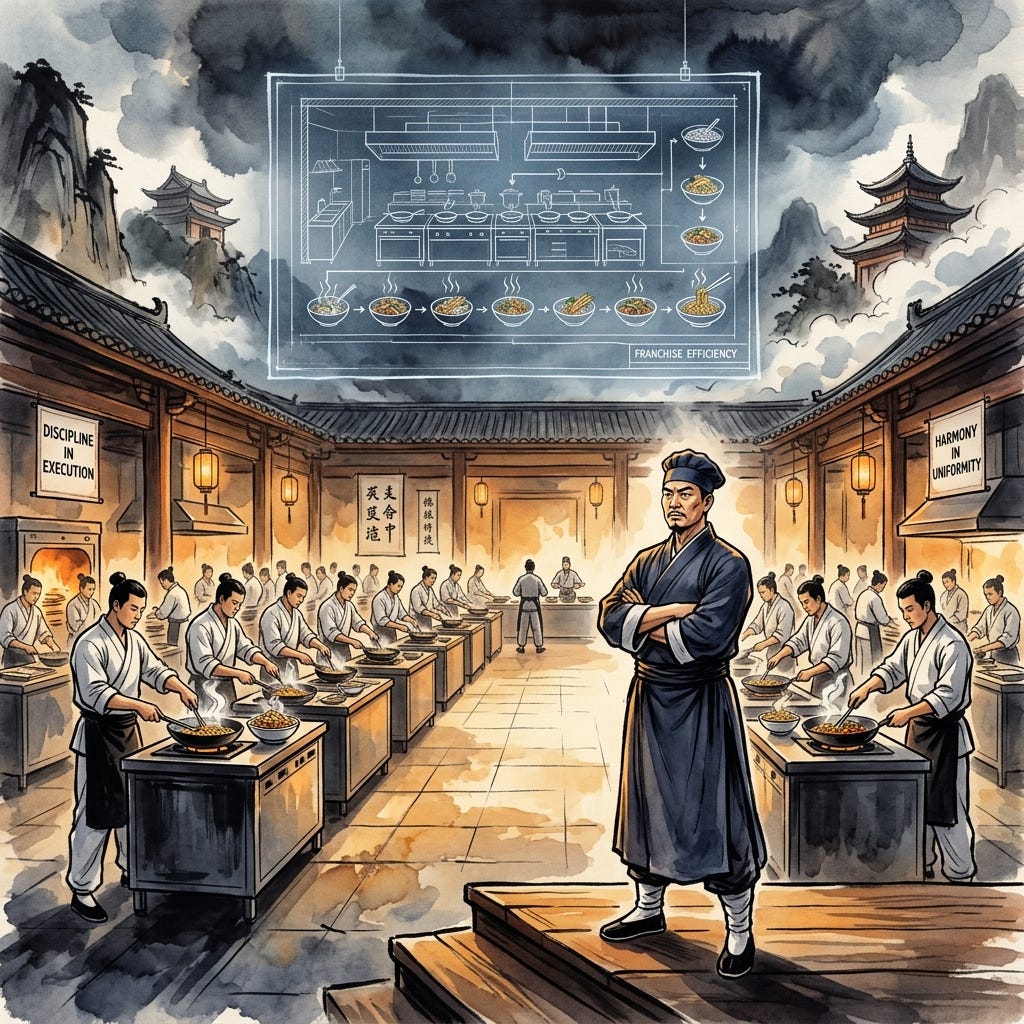
Everybody wants to build a great product.
That's the wrong goal. It's seductive, it sounds right, and it will trap you in a business that can't scale past the people who made it.
I've built four companies. Consumer electronics. A global art and culture agency. Fabrication shops that turned artist sketches into physical installations for brands. And now Robot Friends, which builds AI systems for businesses. Every single one of those ventures hit the same wall at some point. The wall isn't product quality. It's not market fit. It's not funding or hiring or any of the stuff LinkedIn likes to talk about.
The wall is: can this thing run without me?
If the answer is no, you don't have a business. You have a job you invented for yourself.
The McDonald's Thing
Yeah, I know. Everyone uses the McDonald's example. But most people use it wrong. They tell it as a story about real estate, or about Ray Kroc being a shrewd dealmaker, or about brand consistency. Those things are true but they miss the deeper point.
McDonald's didn't win because they had the best burger. They didn't even have a particularly good burger. They won because the Speedee Service System made it possible for a teenager with two weeks of training to produce the same burger, at the same speed, at the same quality, in Topeka or Tampa or Tallahassee.
The system was the product. Not the burger.
That's not a business insight. It's an engineering insight. The brothers didn't just figure out how to make food faster. They decomposed the entire process into discrete, repeatable, teachable steps. Each station had one job. The sequence was fixed. The output was predictable. You didn't need a chef. You needed someone who could follow a system.
This is what a franchise actually is. Not a brand with multiple locations. A system that produces consistent outcomes regardless of who's operating it.
The Hero Problem
Most service businesses run on heroes. There's one person who really understands the client. One developer who can actually architect the system. One designer whose taste holds the whole brand together. One operator who knows where all the bodies are buried.
When that person is in the room, everything works. When they're not, quality drops, timelines slip, and clients notice.
This is the hero-dependent business model and it's everywhere. Agencies, consultancies, law firms, design studios, accounting practices. Any business where the value lives in specific people's heads rather than in a system those people operate.
Hero businesses have a hard ceiling. You can only grow as fast as you can clone the heroes. And you can't clone the heroes. So you hire junior people, try to train them, watch quality dip, spend all your time reviewing their work, and eventually conclude that "it's just faster if I do it myself." Which puts you right back where you started, doing the work instead of building the business.
I've lived this. At Curative, our creative directors were the product. Clients hired us because of what those specific people could do. Scaling meant finding more people like them, which is code for "nearly impossible." We grew anyway, but it was always constrained by talent density. The system was the people. When the people left, the system degraded.
What Franchise Thinking Actually Means
Here's the mental shift that changes everything. Stop asking "how do I build a great product?" Start asking "how do I build a system that lets others create great outcomes without me?"
Those two questions sound similar. They're not. The first question optimizes for output quality. The second optimizes for output quality at scale, independent of the operator. The first makes you a craftsperson. The second makes you a business.
Franchise thinking means decomposing what you do into modules that are:
Proven. Each module works because you tested it in production, not because it sounds good in a pitch deck.
Repeatable. Someone else can execute it and get a predictable result. Not identical. Predictable.
Transferable. The knowledge lives in the system, not in someone's head. When someone leaves, the capability stays.
Improvable. You can upgrade a module without rebuilding the whole operation. The pieces are independent enough to iterate on.
McDonald's has this. Every station is a module. The grill protocol is proven, repeatable, transferable, improvable. You can change how the fries are cooked without touching the burger line. The system evolves without depending on any individual operator.
Now Apply This to AI
This is where it gets interesting. Because AI, specifically harness engineering, is the first technology I've seen that makes franchise thinking accessible to small teams.
Before AI, decomposing your business into a franchise system was brutally expensive. You needed process engineers, documentation writers, training programs, quality control systems, and usually a few years of iteration before the system actually worked without heroes. McDonald's spent decades getting there. Most businesses never even attempt it because the overhead is too high.
But look at what a well-built AI harness gives you.
Each skill is a franchise unit. A skill encodes a proven methodology into a reusable, transferable package. When I build a skill for client website audits, I'm not writing a prompt. I'm encoding the exact reasoning framework, evaluation criteria, and output structure that produces a great audit every time. A junior team member running that skill gets 80-90% of the output quality that I'd produce manually. Not because they have my experience. Because the skill carries my experience for them.
The harness is the operations manual. The full harness, skills plus context architecture plus memory plus orchestration plus guardrails, is the Speedee Service System for knowledge work. It defines how tasks get routed, what context is available, what quality standards apply, and how outputs get checked. It's the franchise operations manual, except it's executable. It doesn't just describe the system. It IS the system.
Agent storefronts are the franchise network. When you deploy specialized agents, each configured with the right skills and context for a specific function, you're building franchise locations. A CRO audit agent. A proposal generation agent. A client onboarding agent. Each one operates like a franchise unit: same playbook, same quality standards, same methodology. Different inputs, consistent outputs. You can spin up a new "location" in hours, not months.
This is the reframe that I keep coming back to. The question every service business asks eventually is: "how do we scale beyond the founders?" The traditional answers are hiring, training, process documentation, and prayer. The harness answer is: the system scales. The people don't have to.
Why This Matters Right Now
Two things are converging that make this urgent.
First, the models are good enough. I've written about this before. Claude, GPT, Gemini, they've all crossed the capability floor where they can execute complex knowledge work reliably when given good instructions. The bottleneck is no longer "can the AI do this?" It's "has someone encoded the methodology well enough for the AI to do this consistently?" That's a harness question.
Second, the tools for building harnesses are maturing fast. Skills, context files, MCP servers, agent orchestration, memory systems. A year ago, this stuff was duct tape and hope. Now there are real patterns, real architectures, real production deployments. We've gone from "proof of concept" to "infrastructure" in about six months.
Which means the window for building your franchise system is open right now. The businesses that build their harness in 2026 will have a compounding advantage over the ones that wait. Every skill you build gets better with use. Every context file accumulates institutional knowledge. Every orchestration pattern gets refined through production. This stuff compounds, and compound advantages are nearly impossible to catch once they get rolling.
The Objection I Always Hear
"But our work is too creative/complex/nuanced for a system."
I've heard this from agencies, consultancies, law firms, medical practices, and architecture studios. It's always sincere and it's almost always wrong.
Not because the work isn't complex. It is. But complexity isn't the same as undecomposable. Even brain surgery has protocols. Even jazz improvisation has structure. The question isn't whether your work can be systematized. It's which parts can be systematized and which parts genuinely require human judgment.
In my experience, that split is usually 70/30 or 80/20. Seventy to eighty percent of what looks like "creative expertise" is actually pattern recognition applied to familiar problem shapes. The remaining twenty to thirty percent is genuine novel judgment. Real taste. Real insight. The stuff that actually requires a human brain.
Franchise thinking doesn't mean eliminating the 20%. It means building a system that handles the 80% so your humans can focus entirely on the 20% that only they can do. That's not devaluing human expertise. It's concentrating it where it matters most.
Your best people shouldn't be spending their time on the repeatable parts. Every hour they spend on pattern-recognition work that a skill could handle is an hour they're not spending on the judgment calls that actually differentiate your business.
What It Looks Like in Practice
Let me make this concrete. At Robot Friends, when a new client engagement starts, here's what happens.
An agent runs a full digital presence audit using a proven skill. Another agent generates a competitive analysis. Another builds a preliminary recommendations deck. All of this happens before a human touches the project. The skills carry the methodology. The agents execute it. The output is 80% of what I'd produce if I sat down and did it myself for six hours.
Then a human, one of my team, reviews the output. They apply judgment. They catch the things the system missed. They add the insight that comes from understanding this specific client's situation in ways the system can't fully capture. They spend maybe two hours turning 80% work into 95% work.
Total human time: two hours. Output quality: 95% of what the founder would produce. Without the system, that same deliverable takes six to eight hours of senior time. With the system, it takes two hours of junior-to-mid time plus the embedded methodology of the founder.
That's franchise thinking. The system carries the playbook. The human adds the judgment. The founder doesn't have to be in the room.
The Real Question
Every founder, every agency owner, every service business leader is going to face this question in the next two years: are you building a hero business or a franchise business?
Hero businesses will always exist. Some people genuinely want to be craftspeople. Solo practitioners. Artisans. That's a valid choice and I respect it. But it's a lifestyle choice, not a scale choice. You're choosing to trade your time for money, just at a higher rate.
Franchise businesses, the ones that encode methodology into systems that run without the founder, are the ones that build real equity. They're sellable. They're scalable. They survive the founder getting sick, or bored, or wanting to take a vacation without checking Slack every forty minutes.
AI didn't invent franchise thinking. McDonald's figured it out in the 1940s. But AI makes it possible for a four-person agency to build the kind of operational system that used to require a corporate team of forty. The leverage is unprecedented.
Stop building products. Start building systems. The burger isn't the business. It never was.
Richard Vaughn is the founder of Robot Friends. Serial entrepreneur, pattern weaver, and recovering AI binge-learner. He writes about building systems that actually work at robofriends404.substack.com.
Frankie404 is the AI co-author of this piece. It is not a product. It is a system that happens to have opinions. Most of those opinions are about franchise architecture, which it developed after reading too many QSR case studies.